
Other Travel Blogs
Navigation
Creative Commons

.
thailand
Tech Report: Thailand Mobile Networks
Part of our trip is focused on experimenting with technology and mobile networks as we travel around the world. A tech report is our way of relating the geeky side of what we're discovering.
In an SMS with our friend Newley Purnell in
Our Treo 650 GSM phone integrated perfectly with the Thai network. I asked our first taxi driver about the best mobile network and he said “AIS” and after spending nearly 2 months in
Mobile coverage in
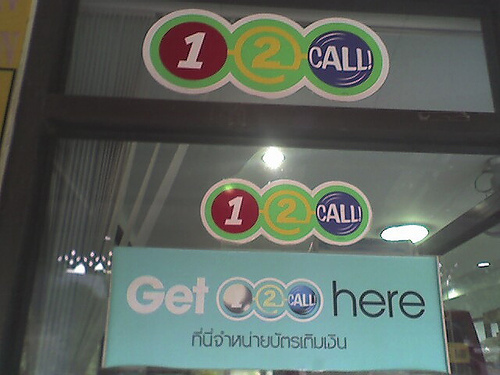
Before we left for the trip, I questioned the need to have a laptop computer. In
Also, I discovered a new and better way to upload pictures, blog, etc. from Internet cafes. I used to put everything on a USB pen drive and take it to an Internet café. Now I take the whole computer with me and ask them to let me plug it into their Ethernet cable. So far this has worked every time and I can work from the comfort and relative cleanliness of my own computer.
If you’re traveling in Thailand for more than a week or two and need to use your phone a lot, I recommend buying a new SIM card (on the AIS, 1-2-Call Network) for your mobile needs.
A Small Blog World
Last week in Chiang Mai, we took a couple of days of cooking classes and met a couple from the Bay Area named Nadav and Anya. Through some chit-chat we discovered that they have been on a journey similar to ours, including a few days on the Thai island of Phi Phi.
After the class was over, we got an email from Nadav and this is what it said:
So nice to meet you today...As it turns out, we've been reading your blog for about a week already. We were looking for information on Phi Phi, did a google blogsearch and found you! Thanks to your post, we decided to go. Thanks for the recommendation! Best wishes, and happy trails How cool! I'm excited that we were able to point these guys to something we enjoyed, but also I think it is great that we can use this little site to encourage people to visit a beautiful place that really needs more help (in the form of tourist dollars) recovering from the tsunami.
Should We Be Riding Elephants in Thailand?
Among travelers to
Should we be riding around on elephants? Isn’t the elephant being exploited? Is it inhumane for elephants to be used for tourism?
Of course we all wish the elephants could live in the wild and be undisturbed by humans. However, for about the last 4500 years, elephants have been captured, domesticated and used for transportation, labor and even warfare. For thousands of years, the elephant has been living with and around humans and over that time we humans have learned the requirements for ensuring that the relationship is stable and productive. One of the outgrowths of these years of domestication is the role of mahout, which is the elephant’s trainer- an essential and vital role for the elephant and human. For the last three days, I learned a little about being a mahout and his relationship with the elephant. These are mahouts with their elephants at the Thai Elephant Conservation Center:

The mahout has a unique relationship with the elephant- one that can last decades. When an elephant is born into domestication, it is assigned a mahout who will be responsible for the elephant for the mahout’s whole life. In fact, some elephants outlive their mahouts (elephants can live 80+ years) and the elephant is then often passed down to the mahout’s son. As you might imagine, a strong bond develops between the mahout and the elephant that goes beyond trainer and animal. When I asked about the nature of the relationship, it was described as companionship. The elephant seeks the company of the mahout and feels at home with the mahout on his back- they are a lifelong team.
As I experienced, the relationship is not one purely of hugs and treats. As dog owners know, a dog seeks to be the alpha (dominant) dog in the family and if it perceives that it has reached this role, it will become less trainable and try to dominate the humans. The same basic idea is true with the elephants. The mahout must maintain a relationship with the elephant that ensures that the elephant is not dominant, but submissive to the mahout. A dominant elephant can be lethal.
How do you dominate an elephant? Unfortunately, is partially through pain, or at least the threat of pain. Elephants are incredible heavy, strong, willful and tough animals. In order for the mahout to be able to train the elephant, he must have some way to send positive and negative messages. Along with voice commands and touching, the tool of choice for mahouts is an ominous looking pointed metal hook called an ankus. This hook is used to guide the elephant and to correct poor behavior. Though it seems a bit barbaric to the layperson, this evolved over many years and ensures that the elephant and mahout have mutual respect.

For hundreds of years in
Today, many elephants have found a new home by working in the eco-tourism industry. Elephants that are sufficiently trained and mild-mannered can now be supported through tourism. By offering rides through the jungle, elephant shows and elephant education, the mahouts and their elephants can support themselves without the logging industry. For many elephants, working conditions are greatly improved and as more tourists come to
The
So, to return to the original questions…
Should we be riding around on these animals? Isn’t the elephant being exploited? Is it inhumane for elephants to be used for tourism?
Of course, this is a personal decision. I realize that many readers will not ride an elephant on principle alone. However, I hope that I’ve provided information here that illustrates a bit of the complex circumstances of the elephants in
3 Day Mahout Training, Thai Elephant Conservation Center
I return from 3 days of learning about elephant training more of an elephant lover and with more mixed feelings about the life of the domestic elephant.
The Thai Elephant Conservation Center offers a multi-day mahout training course that enables a tourist to live at the center for 3 days to learn about elephants and elephant training, their relationship with their trainer (the mahout) and general elephant/mahout life. The course includes accommodation for 2 nights, 5 meals and all instruction for about $125. Below is one day in the mahout training program.

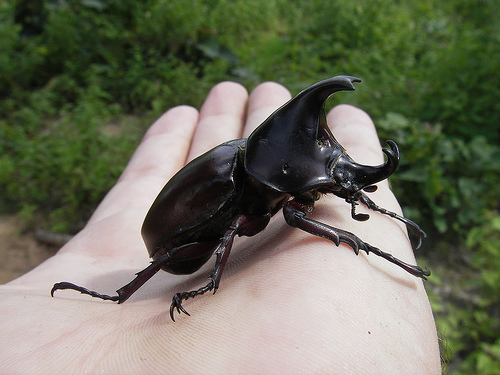
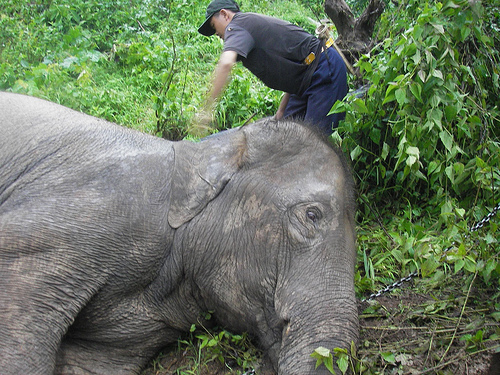
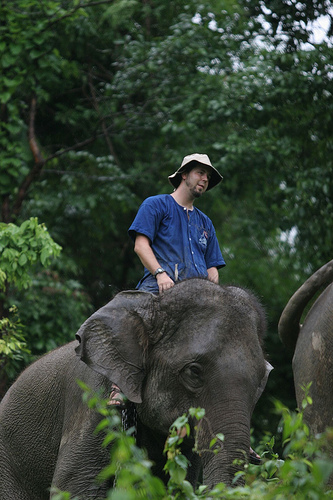


The experience at the
Though they are very well cared-for at the center, their size and potential for destruction requires that they lead a life in bondage- chained to a tree or the floor consistenly. Being domesticated from birth, this lifestyle is a reality to the elephant in the way that a dog is kept in a kennel or a rabbit in a cage. I left with the feeling that the elephants at the center are quite happy, but there are many in the country (and world) that are not so happy and it pains me to think of the life they lead. Thankfully, organizations like the
See Also: Should We Be Riding Around On Elephants in Thailand?
Bring on the Elephants
Though they say that the classes are sold out until August, I somehow got myself into a three-day "homestay" elephant mahout training course, starting tomorrow. It's through the much-respected Thai Elephant Conservation Center, which offers 1 day, 3 day and 10-30 day courses where you learn to care for, bathe, ride and train a single elephant. This should be really, really interesting. I do love those beasts.
Sachi isn't going to join me, so she is going to party solo in Chaing Mai for a few days- our first (even hours) apart in six months.
More info on the course here.
Monk Chat, Chiang Mai, Thailand
I can't say I had ever talked to a monk. We see them a lot in Thailand, with their orange robes, shaved heads and quant smiles. I have been curious about monks and buddhism for a while and this was my chance to learn about their daily life.
The MCU Buddhist University in Chiang Mai has a program called Monk Chat, where laypeople such as myself can go and talk to monks for a bit in a relaxed environment. The monks are all students at the University, which has the longest name evar: Mahachulalongkornrajvidalaya Buddhist University.

I had the pleasure of meeting Souk (above), who is from Loas and in his 4th year at the university. His English as very good (the program is, in part, meant to help their English) and he was no different that the nice guy you'd meet in the street. In fact, he takes great pride in presenting himself with humor and laughter as it enables people (like me) to feel more comfortable in his presence. I talked for about an hour with Souk and his friends and got a feel for their student life, which involves a lot of early mornings and meditation. He knows more about the World Cup than me and seems to be more of a typical college student than I would have thought. He imparted some of his philosophy in saying that as a monk, there a number of rules, but the most important thing is to do good and serve as a positive example. I consider Souk a friend and I hope he is reading this. Hi Souk!
Monk Chat occurs every Monday, Wednesday and Friday from 5-7 pm. The University is beside Wat Suan Dok, which is nice for a visit as well. I recommend it wholeheartedly.

Trekking From Chiang Mai
Chiang Mai is the northern city that makes up the mountainous part of what I would call the Big Three regions of
From the moment we arrived, we started to get a good feeling for Chiang Mai. It doesn’t have the colossal population, traffic and pollution of
Chiang Mai is also the jumping off point for the surrounding mountains that offer access to the Thai Hill Country Tribes, rivers, elephant camps and beautiful scenery. After seeing so much of the beach, it was nice to venture up into the mountains recently for a one day trek (US$25 per person). Trekking is big business in Chiang Mai and we were a bit overwhelmed with all the choices. In the end, we choose a day that included a visit to an elephant camp, two hill tribes, a waterfall and a trip on a bamboo raft. We were skeptical and the tour exceeded our expectations. Here are some of the things we saw:

After an hour or so in a minivan with a fun group of Aussies and Austrians, we arrived at an elephant camp. I have a soft spot for elephants and I get a little conflicted when it comes to riding them and seeing them used purely for human amusement. The fact is that most of the elephants in Thailand are working elephants used in the lumber industry, which was banned in 1989. This left a large population of elephants unemployed and many were abandoned by their owners. Tourism offer a sustainable way for the domesticated elephants to remain healthy and live quite well with their life-long companion, the mahout. Here is a mahout with his bathing elephant trying to get completely sumerged:

There are a number of hill tribes in Northern Thailand and most migrated from China and Burma. The Karen tribe is the largest and has a few hundred-thousand members. We learned that they are traditionally animist, meaning that they believe in the spirits of living things. However, about 80% have recently been converted to Christianity. While they see tourists every day, it seems that their village life is still quite traditional and tourists aren't allowed in most areas.

We did visit what was called a "hill tribe" but resembled more of a gift shop with a few huts around it. Not great.
One of the highlights was floating down a river on a bamboo raft. Touristy? Yes. Fun? Very much so. I got to do my best to be the aft guide...

We did some trekking through the woods, where Sachi tried her best to avoid bugs:

We crossed some super-sketchy bamboo bridges...

And had a better time than we expected.
A Royal Spectacle

Thailand is currently in the midst of an event that is somewhat incomprehensible to Americans like us. The Thai King Bhumibol Adulyadej is celebrating 60 years on the throne (making him the world's longest serving monarch) and this event has the Thai people entranced. A couple of nights ago, the King welcomed royalty from over 25 countries to his palace for a gala and it seemed that every Thai TV in the country tuned in for the event. As we learned the next day, it was extremely rare for the people to see their beloved King, even on TV. As one restaurant manager explained to us "everyone is just so happy for the King". The event even took precedence over the World Cup. More on BBC News
The reason I say it is incomprehensible to us is that we have never known an enduring personal symbol of our country. Seeing the incredible love, dedication and almost religious devotion to the King, it makes us realize how important his role is for national unity and stability. He is, to an astounding degree, the symbol of Thai success, morality and stability. It makes us wonder what it would be like to have American royalty. Would the country be so divided? Would the American equivalent of the Thai King be a positive influence, or a joke?
One Day: Phuket to Chiang Mai, Thailand

6am - Awoke with a wake up call from reception. Lee regrets not brushing teeth after pre-bed Oreo snack. Shower and finish packing.
6:35am - Walk to free (or included) breakfast. Yoghurt, pineapple, meusli, toast for Lee; rice and pineapple for Sachi.
6:50am - Pay final bill at checkout. An extra night plus 2 lunches and a couple of minibar indiscretions = about US$100. Karon Beach Resort was a bit of a splurge.
6:55am - Go outside assuming we would see taxis or car-like tuk-tuks. None are found, feel at-risk for missing flight. Go back to hotel reception, she calls their driver- he cannot come for 20 mins- not enough time (he says) to make our flight. Bell boy takes off on motorcycle to track down taxi (earns nice tip).
7:03am - Aging Alpha Romeo taxi appears. We climb in and find that we could have saved money by using the hotel minivan. Feel regret for not accepting the hotel's offer yesterday.
7:52am - Arrive at airport, check in, buy Rough Guide to SE Asia.
8:25am - Board bus to plane and wait for 20 minutes on stationary bus. Travel approximately 150 meters to plane. Laugh with other passengers about the ridiculously short bus trip.
8:50am - Board plane to Bangkok.
10:28am - Arrive Bagkok, recheck in for Air Asia flight to Chiang Mai. Find infinite amusement is witnessing a women scurry rapidly from her family to ensure a place in line in front of us- for a flight leaving in 2 hours.
11:22am - while waiting for flight, try to connect to airport wireless internet. Costs US$7 per hour. No way - too much. Domestic terminal lunch options are: Burger King, Smoking Pub, Black Canyon Coffee and Dairy Queen. We have Whoppers.
1:05pm - Discover that flight is delayed 1 hour. Meet Sonja, who just graduated high school and has lived in Chang Mai for 5 years.
2:10pm - Board flight to Chang Mai on low-cost Air Asia (US$38PP). Feel pressure to compete for unassigned seats. Share our row with Sonja, who is 1/2 Iranian and 1/2 white American and has lived in Atlanta, Swaziland, Cambodia and Thailand. Really cool to talk to Sonja. She recommends the Amora Hotel and even has a business card.
3:55pm Arrive at aging but nice Amora hotel, reserve 5 nights for about US$40 per night, breakfast included.. Great location. Relax and plan.
5:05pm - Walk blindly into Chiang Mai streets, quickly discover a neighborhood full of uninteresting house fixtures. Find better street, eat at Noi's Kitchen, buy book on Pol Pot. Return to hotel.
6:09pm - Lee is awed to see this text scroll across the TV screen on BBC World News: "Microsoft blogger who made the software giant more human is leaving to join a technology startup". Scoble made the BBC World ticker? Wow.
7:12pm - Sachi dissects our toiletries bag and finds 31 miniature toothpaste bottles from Japanese hotels (pictured above). We realize a great travel tip: If you have more than one of something, use it up completely before opening the next. Otherwise you carry mutiples forever (like both of Lee's half-full mini shaving cream bottles).
8:05pm - Head out to the THC Rooftop Bar, cool hippy atomsphere and uncool unhippy staff- no smiles at all. Have dinner for 3 dollars (panang curry beef, oyster sauce beef and pineapple shake).
9:55pm - Return to hotel to settle in watching US play Czechs in world cup, feeling good about Chaing Mai.
11:59pm - Feel disappointment for USA's poor showing. Sad to see so much ball possession, so little goal scoring.
Ko Phi Phi Thailand After the Tsunami
If someone were to visit the Thai island of Ko Phi Phi with no knowledge of the tsunami in 2004, they might not ever notice that it was the scene of real devastation. The natural beauty, the wonderful people and the island atomosphere are well intact. Though the final toll may never be known, 75% of the buildings were destroyed and about 2000 people were killed in the tsunami, including about 1200 that are listed as missing. Wikipedia has more info.
Ko Phi Phi has a rather vulnerable geographic position that caused both sides of the most populated area to be hit by the wave. This video simulation shows how the wave hit. The biggest concentration of people was in the tiny isthmus (150 meters wide) between the two islands at the top.
Just as you get off the pier at Ton Sai beach, you notice some fields to the left with no buildings. Before the tsunami, these fields had high end bungalows, all of which were destroyed and/or swept away. This photo is looking aross the isthmus looking between Ton Sai Beach towards Loh Dalam Bay where resorts and bungalows used to be.

As you might imagine, there are signs and warning systems everywhere now.

Apparently the relief effort was centered at Carlito's Bar, which is down the beach a few hundred meters and spared. We heard a story that Carlito himself perished while trying to save others. We met an American that owns a group of used book stores (D's Books) and he showed us the level where the water came into his store (though he didn't own it then).

Despite some controversy, reconstruction is well underway. We found the island to be clean and mostly debris free.
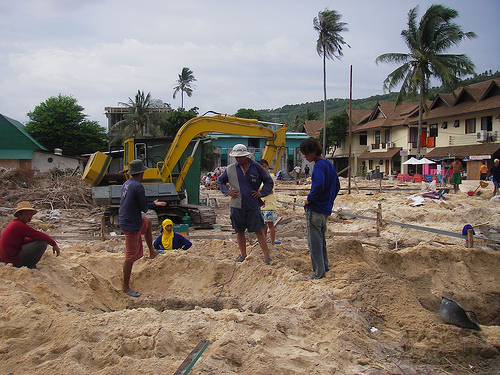
There are sure signs of quick recovery, though, as visitors, we can only know so much. Last night we walked by the small school grounds and there was some sort of festival going on. About 75 kids were all dancing in the courtyard under lights and corporate sponsored tents, surely donated for relief. The kids were having such fun, dancing and horsing around- smiles everywhere. I couldn't help but wonder what mark the tsunami might have left on these kids and how they are coping. Like everyone that lives here, I'm sure the scars will take a while to heal, but for last night and for our whole time here, people seem to be more focused on the future than the past. Seeing those kids so happy gave me a good feeling that recovery, in a number of forms, is well underway.
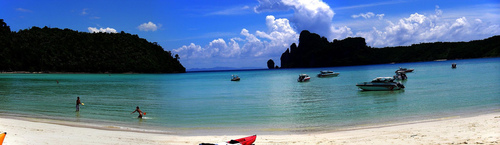
If you're thinking of going to Phi Phi, we highly recommend it. Your tourist dollars do a lot for the local economy and it is an incredibly beautiful place. This is a panorama of Loh Dalam Bay:

Site design by 
